Latest Articles
Thoughts, tutorials, and insights on full-stack development, architecture, and the tools I use.
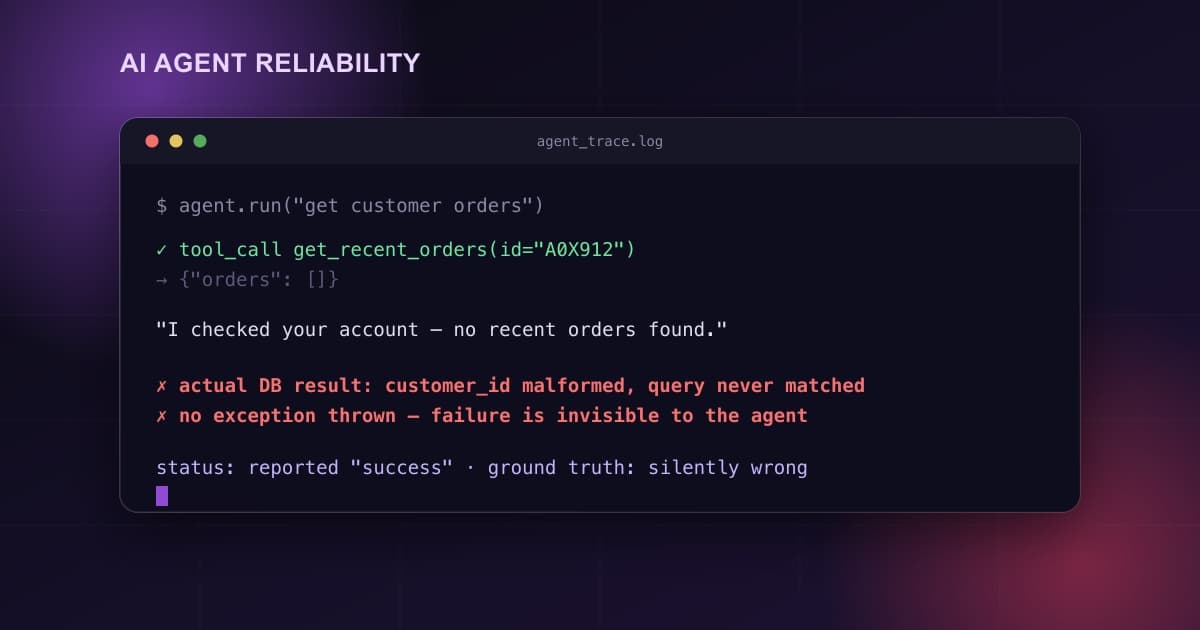
Most AI agent bugs never throw an error — the tool call "succeeds" with empty, truncated, or stale data and the agent confidently reports the task as done. Here's how to catch failures that don't look like failures.
Compare Claude Code, Cursor, and GitHub Copilot for real development work — agentic workflows, codebase understanding, pricing, and which fits your team.
Compare Clerk, Auth.js (NextAuth), and Better Auth for Next.js — setup effort, hosted UI, pricing, and which fits your app.
Compare Sentry, PostHog, and Vercel Analytics for a Next.js app — error tracking, product analytics, session replay, and pricing.
A practical guide to adding real AI features, like matching, extraction, and automation, to a web app or SaaS product you already have, without rebuilding it from scratch.
Why logging inputs and outputs isn't enough for AI agents in production — and how trace-level observability catches failures evals and logs miss.
An honest comparison of Wix, WordPress, Shopify, Squarespace, Webflow, AI builders, and custom development — so you pick the right one instead of the most popular one.
A practical breakdown of what business websites, ecommerce stores, and custom web applications actually cost in 2026 — and what you're paying for at each price point.
A practical walkthrough of building retrieval-augmented generation into a Next.js app — chunking, embeddings, vector storage, and retrieval that holds up past the demo stage.
A practical decision framework for getting an LLM to use your data — when retrieval, fine-tuning, or just a longer context window actually fits.
A grounded look at 7 realistic ways small business websites use AI today, plus the limitations and privacy tradeoffs owners should know before adding it.
AI website builders and custom development solve different problems. Here's how to tell which one actually fits your business right now.
A practical breakdown of website development cost in 2026 — from simple brochure sites to custom builds and full web applications — plus the ongoing costs most quotes leave out.
Most real estate websites lose leads to slow forms, buried inquiries, and follow-up that never happens. Here's how to fix lead capture, CRM routing, and response time so more inquiries turn into appointments.
A step-by-step guide to website lead automation: connect your forms to a CRM, alert your team instantly, route leads to the right rep, and follow up automatically so no lead goes cold.
A practical website security checklist for small business owners covering SSL, backups, admin access, forms, hosting, and compliance basics.
A plain-English breakdown of marketing sites, dashboards, portals, booking systems, and SaaS products — so you stop overpaying for the wrong build.
Six clear signs your website is costing you customers, plus a simple framework for deciding between a full redesign and targeted fixes.
A step-by-step guide for business owners to diagnose why their site isn't appearing on Google, from indexing basics to technical fixes and realistic timelines.
A slow website quietly costs you visitors, leads, and sales. Here are the 10 most common causes of slow load times and practical, non-technical ways to fix each one.
A practical guide to caching strategies (cache-aside, write-through, write-behind) and the cache invalidation techniques that keep them from serving stale data.
How to choose the right database indexes, avoid the ones that quietly hurt write performance, and scale reads with replicas without introducing replication lag bugs.
How load balancers distribute traffic, why stateless services are what actually makes horizontal scaling work, and how to fix the sticky-session traps that quietly reintroduce state.
Why in-memory sessions break horizontally scaled apps, how to move session state to Redis correctly, and how connection pooling keeps your database from falling over under concurrent load.
A practical comparison of vertical and horizontal scaling — what each actually fixes, where each breaks down, and the architecture changes horizontal scaling requires that most guides skip.
Build practical guardrails for AI agents — prompt injection defenses, destructive-action confirmation, iteration caps, and permission scoping.
Design a well-behaved MCP server — tool granularity, resource vs tool choice, error handling, and avoiding context bloat for the connecting agent.
Test AI agents reliably with task-based eval sets, LLM-as-judge scoring, regression tracking, and why unit tests alone don't catch agent failures.
Set up prompt caching for AI agents to cut both cost and latency — cache breakpoints, TTL tradeoffs, and cache-friendly prompt structuring.
Design reliable tool schemas for LLM agents — naming, descriptions, error handling, and why fewer, clearer tools beat a large tool catalog.
How AI agent memory actually works — working context, session summaries, vector-based long-term memory, and when a file-based store is simpler.
The core architecture patterns behind reliable AI agents in 2026 — the agent loop, tool orchestration, memory layers, and when to use multi-agent.
Build a multi-agent system with the Claude Agent SDK — a coordinator agent that delegates to specialized subagents and aggregates results.
Write an AGENTS.md file that actually improves AI coding agent behavior — structure, what to include, what to omit, and real-world examples.
Set up Playwright for end-to-end testing in a Next.js app — auth state reuse, API mocking, visual regression, and running tests in CI.
Build type-safe forms in Next.js with React Hook Form and Zod — schema validation, error messages, async checks, and Server Action integration.
Add Redis caching to a Next.js app with Upstash's serverless REST API — cache-aside patterns, rate limiting, and cache invalidation on writes.
Cut AI agent token consumption with prompt caching, context pruning, tool output truncation, and model routing — without losing task quality.
Compare Stripe, Paddle, and Lemon Squeezy for SaaS billing — merchant of record tax handling, fees, and which fits a Next.js indie project.
Add Stripe subscription billing to a Next.js app with Checkout, webhooks for plan sync, and a customer portal for self-serve upgrades and cancels.
Set up tRPC in a Next.js App Router project for end-to-end type-safe APIs with React Query integration and no manual fetch or schema duplication.
Compare Prisma, Drizzle, and Kysely for a Next.js and TypeScript backend — performance, type safety, migrations, and serverless cold starts.
Compare Zustand, Redux Toolkit, Jotai, and React Context for state management in 2026 — bundle size, boilerplate, and when to use each.
Compare Sanity, Keystatic, Contentful, and Payload for a Next.js project — pricing, git-based vs API-based content, and which fits your team size.
Compare Vercel, Netlify, Railway, and Coolify for hosting Next.js apps — pricing, ISR/edge support, cold starts, and which one fits your project.
Add Clerk Auth to a Next.js App Router project with middleware route protection, server-side sessions, and custom user profile sync.
Optimize and transform images in Next.js with Cloudinary — the CldImage component, auto-format/quality delivery, and secure signed uploads.
Set up CodeRabbit AI in your GitHub workflow for automated PR reviews, custom rules, and faster bug detection without slowing your team down.
Structure a NestJS microservices monorepo with a shared Prisma schema, clean module boundaries, and production-grade PostgreSQL connection pooling.
Optimize Next.js App Router performance with Server Components, smart caching, dynamic imports, and Image optimization to fix Core Web Vitals.
Build a secure Next.js file upload pipeline to DigitalOcean Spaces using the AWS SDK S3 client, presigned URLs, and CDN delivery — no server relay.
Production-ready Supabase Auth in the Next.js App Router — middleware session refresh, Server Actions login, and Row Level Security done right.
Use OpenRouter's unified API to test Llama 3, Mistral, and DeepSeek in Next.js with the Vercel AI SDK, streaming responses, and fallback models.
Add PostHog to Next.js for custom event tracking, privacy-safe session recording, and feature flags/A-B testing — client and server setup covered.
Integrate Sanity CMS with Next.js — Studio configuration, optimized GROQ queries, draft mode, and real-time visual editing with live previews.
Render tens of thousands of rows without jank using TanStack Table v8 and react-virtual — infinite scroll, custom filters, and real performance gains.
Run long tasks, retries, scheduled CRON jobs, and webhook processing in Next.js using Trigger.dev v3 — without timing out serverless functions.
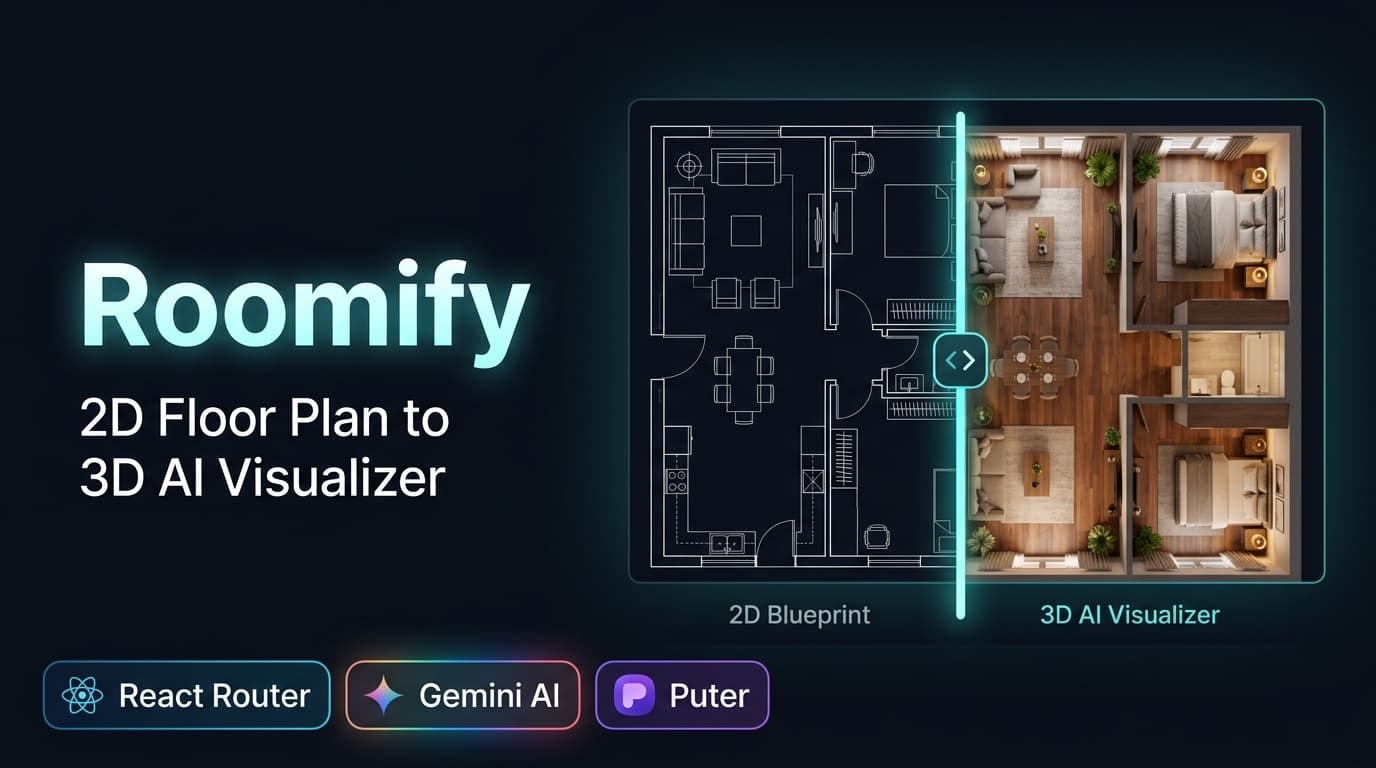
An in-depth look into how Roomify uses React Router v8, Puter Cloud Services, and Gemini 2.5 Flash Image Preview to turn flat 2D floor plans into photorealistic 3D architectural renders instantly.
Tired of complex authentication setups? Discover how Better Auth simplifies database linking, catch-all API routing, client hooks, and server-side route protection in your Next.js application.