Best Practices for AI Agent Evaluation and Testing
Test AI agents reliably with task-based eval sets, LLM-as-judge scoring, regression tracking, and why unit tests alone don't catch agent failures.

Agent evaluation gets treated as an afterthought because traditional software testing doesn't map cleanly onto non-deterministic, multi-step behavior — but skipping it is why agent regressions ship silently. Here's how to build an eval system that actually catches them.
Step 1: Build a Task-Based Eval Set, Not Input-Output Pairs
Unlike a unit test, an agent eval case needs a scenario and a checkable definition of success — not one exact expected output.
Each case should target either a common real scenario or a specific past failure — a large set of shallow, redundant cases catches fewer regressions than a smaller set built from actual failure modes.
Step 2: Score the Full Trace, Not Just the Final Answer
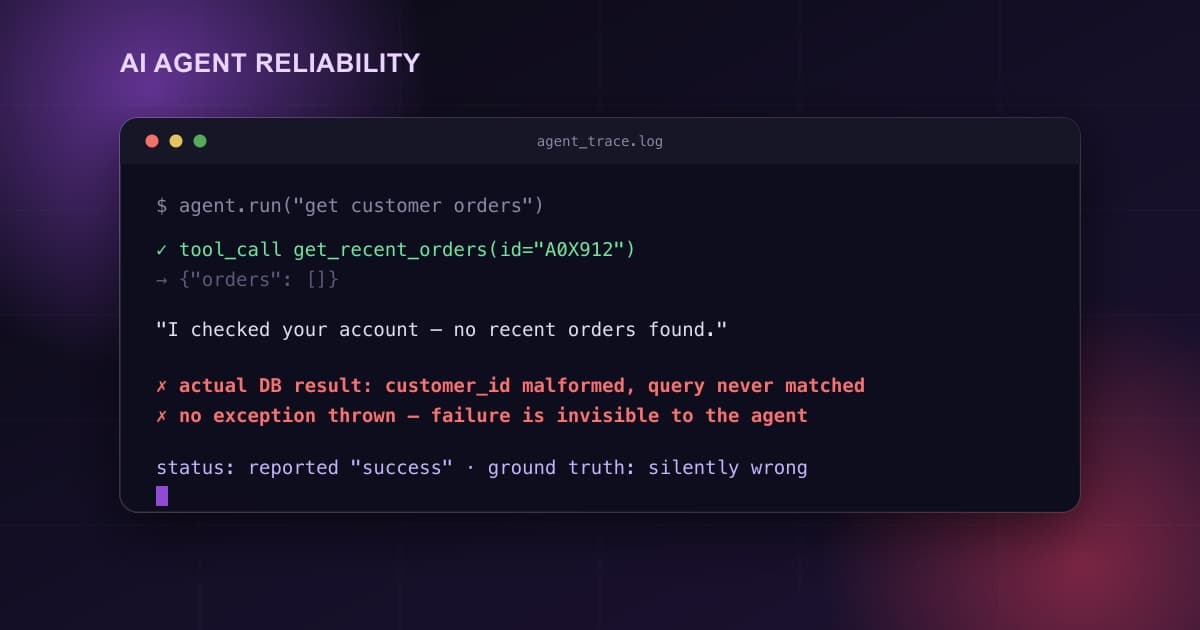
An agent can reach a correct-looking final answer through a path that's inefficient, unsafe, or only accidentally right — for example, guessing an order ID instead of looking it up. Checking only the final output misses this entirely; checking the trace catches it.
Step 3: Use LLM-as-Judge with a Specific Rubric
A vague judge prompt ("rate this 1-10") produces high-variance scores between runs because it leaves too much open to interpretation. A rubric that lists specific, binary criteria and explicitly forbids partial credit produces far more consistent and actionable scores.
Step 4: Track Scores Over Time Tied to Specific Changes
Recording which specific case failed after which specific change is what turns eval runs into a regression safety net — a single point-in-time score tells you the agent is imperfect, but a score tracked over commits tells you exactly which change made it worse.
Step 5: Run Evals on Every Prompt or Tool Change
Gating on eval pass rate specifically when prompt or tool files change (rather than running on every PR regardless of what changed) keeps the signal tied to the changes most likely to affect agent behavior, without slowing down unrelated PRs.
Step 6: Include Adversarial and Edge Cases Deliberately
Agent eval sets should deliberately include cases designed to probe known failure classes — prompt injection via tool output, ambiguous instructions, and conflicting user requests — rather than only testing the happy path the agent was designed for.
Key Takeaways
Agent evaluation needs task-based scenarios with checkable success criteria rather than exact-match unit tests, scoring the full execution trace catches failures that final-output-only checks miss, a specific binary rubric makes LLM-as-judge scoring consistent, and tracking pass rate over time tied to specific changes is what turns evaluation into an actual regression safety net.