Generative Engine Optimization (GEO) — How to Get Your Website Cited by ChatGPT, Perplexity, and AI Overviews
More of your customers now ask ChatGPT or Perplexity instead of scrolling Google results. Here's what Generative Engine Optimization actually is and the practical changes that make AI search engines cite your site.
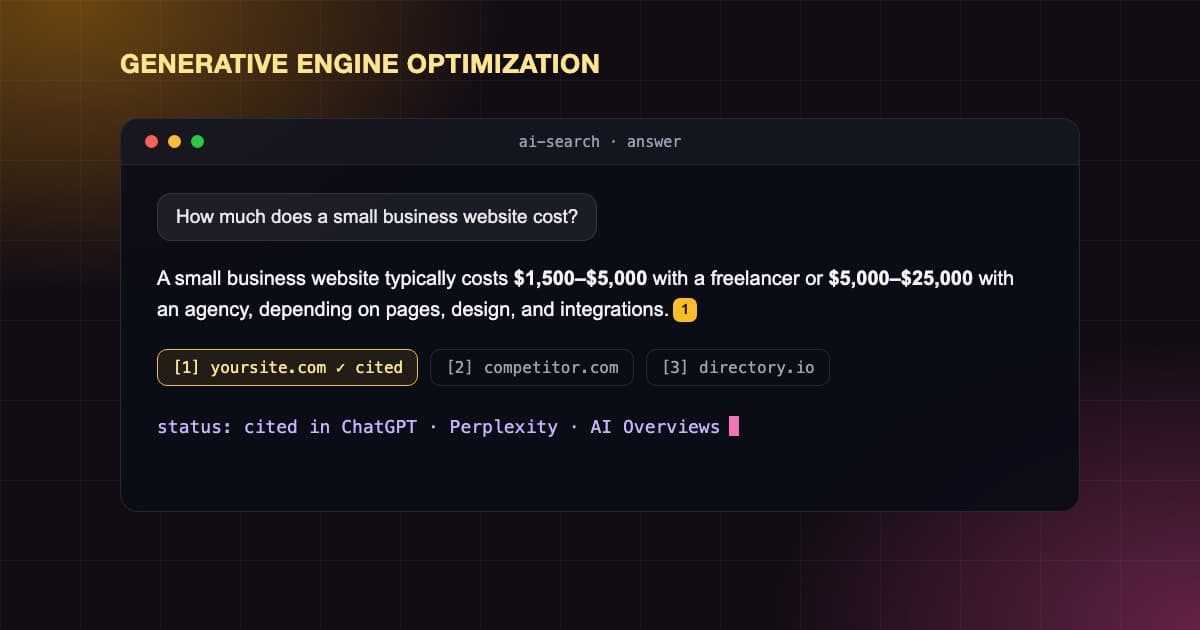
A growing share of people no longer type a query into Google and scan ten blue links. They ask ChatGPT, Perplexity, or Gemini a full question and read a generated answer — and Google itself now shows an AI Overview above the results for many searches. If your website isn't one of the sources those answers cite, you're invisible for that question, even if you technically rank on page one.
Generative Engine Optimization (GEO) is the work of becoming one of those cited sources. The good news is that it isn't a separate discipline you need to start from scratch. It's classic SEO with a sharper focus on how AI systems pick, extract, and quote content.
Step 1: Understand How AI Search Engines Choose Sources
Most AI search products work in roughly the same way:
Two things follow from this. First, retrieval comes before generation — if your page isn't crawlable and indexed, it never enters step 2. Second, the AI quotes passages, not pages. A 3,000-word article with the answer buried in paragraph fourteen loses to a shorter page that answers the question cleanly in the first two sentences under a matching heading.
If your site has basic indexing problems, fix those first — why your website isn't showing up on Google covers the checklist.
Step 2: Make Sure AI Crawlers Are Allowed In
Many sites block AI crawlers by accident — a robots.txt rule copied from a template, or a security plugin with an aggressive bot filter. Check that the crawlers used for search and citations can reach you:
This is the distinction most site owners miss: training crawlers (GPTBot, Google-Extended) and search crawlers (OAI-SearchBot, Googlebot) are separate user agents. You can opt out of having your content used to train models without disappearing from AI answers.
Also confirm your important content is present in the server-rendered HTML. Many AI crawlers don't execute JavaScript, so text that only appears after client-side rendering may simply not exist for them.
Step 3: Lead With a Quotable Answer
The single highest-impact change is structural. Under each heading that matches a real question, put a direct, self-contained answer of 40–60 words first, then expand on it.
The second version can be lifted into an AI answer word-for-word and still make sense. That's the test: if a passage needs the paragraphs around it to be understood, it's hard to cite.
Step 4: Write Headings the Way People Ask Questions
People type full questions into AI tools — "what's the best CMS for a small Next.js site" rather than "headless CMS". Phrase headings and FAQ entries in that natural form, because the AI's rewritten search queries tend to match them.
Good sources for real phrasing:
- Google's "People also ask" boxes for your topic
- Questions your customers actually send you by email or chat
- Search Console queries containing who, what, why, how, or best
- Reddit and forum threads in your niche
A dedicated FAQ section at the end of key pages, with each answer kept short and specific, gives AI engines a set of ready-made question-answer pairs to draw from.
Step 5: Add Specifics an AI Can Attribute
Language models favor content that contains verifiable, concrete details — because those are what an answer needs a source for. Generic advice ("make sure your site is fast") is everywhere and rarely cited. Specific claims are cited constantly.
Add things like:
- Numbers: prices, timeframes, benchmarks, percentages
- Original data: results from your own projects, surveys, or tests
- Named steps and tools: "set up Google Search Console, then submit your sitemap"
- Dates: "as of October 2026" signals the information is current
- Clear authorship: a real author name, credentials, and an "updated" date
Each of these gives the AI a reason to cite you rather than paraphrase the general consensus.
Step 6: Add Structured Data That Matches the Visible Content
Schema markup helps search engines — and the AI systems built on top of them — understand what a page is and who wrote it. For articles, Article (or BlogPosting) and FAQPage are the most useful:
Only mark up what's actually visible on the page. FAQ schema for questions that aren't shown to readers is treated as spam and can hurt you.
Step 7: Measure AI Visibility, Not Just Rankings
Traditional rank tracking doesn't show whether you're being cited. Build a simple routine instead:
- Spot-check monthly. Ask your top 10–20 customer questions in ChatGPT Search, Perplexity, and Google, and record which sources are cited.
- Track AI referrals. In your analytics, filter referral traffic from chatgpt.com, perplexity.ai, gemini.google.com, and copilot.microsoft.com.
- Watch your server logs. Visits from OAI-SearchBot, ChatGPT-User, and PerplexityBot confirm those engines can reach and read your pages.
AI referral visitors often convert better than average search traffic, because they arrive already knowing what you offer and why the AI recommended you.
Key Takeaways
Generative Engine Optimization isn't a replacement for SEO — it's SEO tuned for engines that quote passages instead of listing links. Make sure AI search crawlers can reach your server-rendered content, lead every key section with a short answer that stands on its own, phrase headings the way real people ask questions, and fill your pages with specific, attributable facts. Do that consistently and your site stops being one of the ten links nobody clicks and becomes the source the answer is built on.